
(This post was updated in July 2025 to include more recent data.)
Surely, you’ve seen memes or heard claims that all the new solar installations in Maine are why our electricity costs are so high. Those who make these irresponsible claims—including some public officials—either don’t understand how our energy system works or don’t care. But here’s the truth—the opposite is true.
First, let’s talk about your electric bill.
Here is my latest one from CMP.
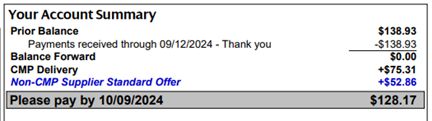
Two important lines are “CMP Delivery” and “Non-CMP Supplier Standard Offer.”
Despite this labeling, many people don’t realize that CMP does not sell electricity—it only delivers it. They are allowed to charge “CMP Delivery” for that service.
Suppose you are one of the 90% of customers that are supplied by the “Standard Offer.” In that case, the other line on your bill is the cost of electricity bought by the Maine Public Utility Commission from the New England wholesale market. They buy it once a year, usually in November, which fixes the following year’s price.
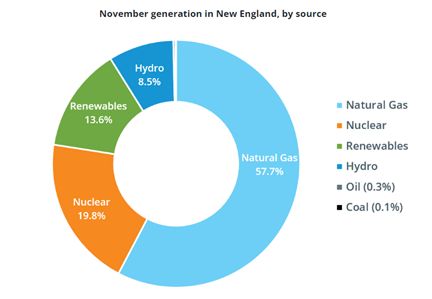
Over half of that wholesale market comes from power plants burning natural gas, which has a significant influence.
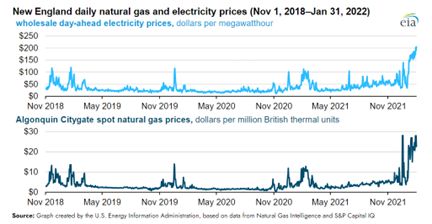
In fact, if you track the ups and downs of gas prices with electricity prices over the last 6 years, they match.
Now, let’s put all the pieces together and look at the total bill. The red parts of the bar are CMP costs. Green is the Standard Offer Supply, and blue is a charge from the regional grid to get electricity into Maine. We’ll talk about the orange bars, which are the costs of solar in in 2022, 2023, 2024 and 2025, later.

So what can we do about this? It’s easy to see that supply is the real culprit since 2021, going up 57% since 2021 and delivery going up 44%. In 2025, these two costs are 75% of your bill.
The best way to reduce supply cost is to use less power generated from natural gas. Every new kilowatt hour from cheaper sources like solar or imported power from Quebec replaces a kilowatt hour produced from natural gas. Without these new sources replacing gas, our bills would be much higher.
The next biggest change is the red bar, the cost of delivering power. The more we make the operation of that grid more efficient, the lower this cost will become.
Now, to the myth- and it is a myth – that new solar panels in Maine are increasing electric bills.
New solar projects are indeed paid extra, and those costs are built into your bill. For CMP residential customers, these costs are the little orange slice in the bars in the chart above, not quite 7% this year.
But your bill doesn’t tell you about the benefits of solar that keep costs down.
First, solar energy removes expensive natural gas, which, as we saw, directly affects the standard offer price. The regional grid operator just illustrated the role of just rooftop solar in a recent article about a day in April. This situation occurs every day, in varying degrees.

All of the light yellow, yelllow, purple and blue portion of the day is power from renewables that would have otherwise been provied by natural gas.
Second, the old-fashioned way to meet new grid demand was to install more poles and wires – and their costs are part of the Delivery portion of your bill. Putting new solar panels near where customers need power avoids some of that expense.
Then there’s the environmental benefits. In addition to keeping costs low, solar energy reduces our reliance on fossil fuels, lowers pollution, and helps us meet our climate goals.
This is not to day NEB costs are not important- they are – but we should be focusing on other parts of the bill first.
There are two issues with Net Energy Billing that merit discussion – how those costs are allocated to customers – and future growth in these costs.
For the last few years the PUC has implemented different methods to allocate those costs to arious custgomer groups. Those allocations were particuallry inquitable for large customers. In July 2025 the PUC revised its allocation formula to mitigate this problem.
On cost growth- legislation was just passed, effective in September, that caps growth in NEB costs and ends the incentives that were part of the current program. New solar installations will compete entirely on competitive costs.
So the next time someone tells you solar is responsible for all these bill increases you can tell them to go do their homework.